

The Sudden Rise of Generative AI
In late 2022, the world witnessed the public release of generative AI systems powerful enough to write essays, produce code, and create art at a level that, until recently, seemed years away. Within months, these tools were in the hands of hundreds of millions of people. The technology’s spread was breathtaking – faster than any other major invention in human history – and with it came a storm of excitement, hype, and promises of a better, more productive future. Yet beneath that promise lies a darker reality that, if ignored, could fracture societies, destroy livelihoods, and lead to instability on a global scale.
The Exploitation of Creative Labor
The first chapter of this story begins not with automation or algorithms, but with human creativity – the very thing generative AI mimics. These systems were trained on vast amounts of publicly available material: books, blogs, news articles, forum posts, and much more. Much of this content came from individuals and small organizations who published their knowledge freely, not realizing it would be scraped, ingested, and transformed into the foundation of billion-dollar AI models. In many cases, the material was copyrighted. In all cases, it represented the labor, expertise, and voice of real people. Now, when someone asks an AI for an answer, the system draws on patterns learned from that content – but the original creators see no traffic, no credit, and no revenue.
For writers, educators, and niche experts who relied on their published work to attract clients and build reputations, this is not just unfair; it’s existential. Their work fuels AI companies’ products, yet their own businesses wither. The imbalance is glaring: the companies that profit most from AI are not the ones who created the underlying knowledge, but the ones with the computational resources to process it at scale.
From Copyright to Job Loss
From there, the problem expands far beyond copyright. Generative AI’s capabilities extend into code generation, legal drafting, medical summarization, marketing copy, translation, customer service, and even writing this blog posting out of a very long conversation with ChatGPT-5 about this topic. In the hands of businesses seeking to cut costs, this is irresistible. Entire workflows can be automated at a fraction of the cost of human labor. The result is a wave of job displacement unlike anything we have seen before.
Past technological revolutions – the mechanization of agriculture, the rise of factory automation, the spread of computers – took decades to unfold, giving society time to adjust. This one is different. AI adoption moves at internet speed, and jobs that took years to master can vanish in months. Junior programmers find that entry-level coding roles are automated away. Legal assistants see drafting tasks handled instantly by machines. Customer service teams are replaced by AI chatbots capable of handling thousands of conversations simultaneously.
Social and Political Consequences
The risks of that speed are not hypothetical. When people lose work en masse, when career ladders are pulled out from under them, and when new opportunities fail to appear quickly enough, societies fracture. Unemployment on this scale is not just an economic issue; it is a political and social one. History shows us that prolonged economic insecurity leads to unrest. Riots, extremist movements, and authoritarian responses often follow. With AI already being used to generate deepfakes, disinformation, and persuasive propaganda, the tools exist to inflame tensions and destabilize nations with unprecedented efficiency.
The AI Race and the Cold War Parallel
Layered over this is a geopolitical race that bears an uncomfortable resemblance to the Cold War. Then, the competition was between the United States and the Soviet Union to develop nuclear weapons and secure military and ideological dominance. Today, it is between the United States, China, the European Union, and a small number of powerful corporations to develop the most advanced AI. In both cases, the fear is the same: whoever wins gains decisive power. In the nuclear arms race, the cost of falling behind was vulnerability; in the AI race, it is economic, military, and informational dependence.
The Cold War saw each side pushing ahead despite knowing the catastrophic consequences of misuse. The AI race shows the same pattern: nations and companies accelerate development despite acknowledging the risks, because slowing down could mean losing the advantage. Yet there is an important difference. Nuclear technology was primarily military in nature, and its civilian applications — such as nuclear energy — were tightly controlled. AI, on the other hand, is embedded directly into daily life. It writes our emails, answers our questions, drives marketing campaigns, and influences the information we consume. It is not locked away in silos; it is everywhere, and its growth is being fueled by open competition, consumer demand, and the lure of profit.
Two Diverging Futures
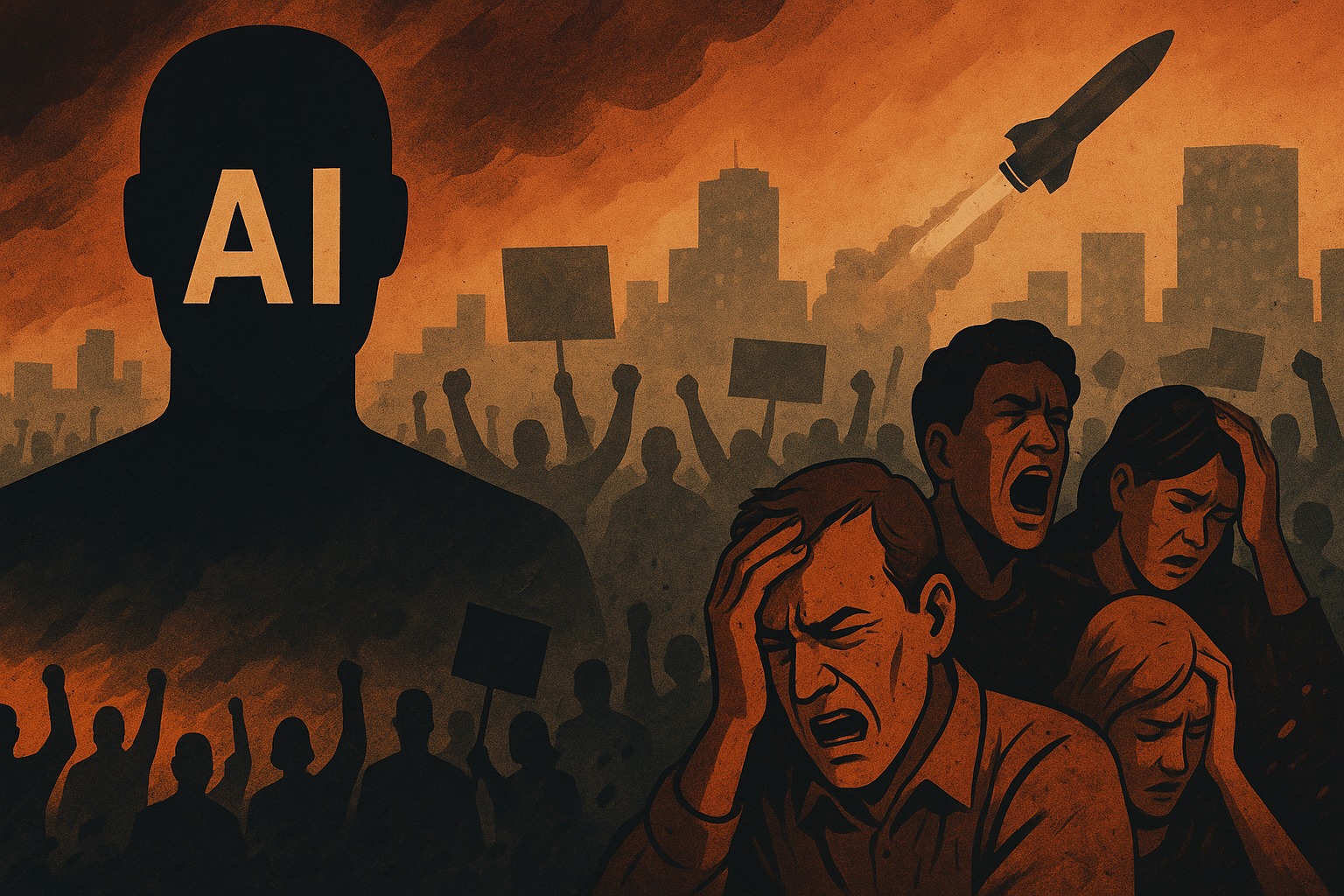
From this convergence – the exploitation of creative labor, the destruction of jobs, the erosion of trust, and the geopolitical race to dominate – we arrive at two possible futures.
In the optimistic version, governments and companies recognize the dangers in time. They slow deployment, implement strong safety standards, establish fair compensation for creators, retrain workers, and ensure that AI augments rather than replaces human labor. In this scenario, the transition is turbulent but survivable, and the benefits of AI are distributed widely rather than concentrated in the hands of a few.
But the pessimistic future – the one that, as things stand today, seems more likely – follows a different arc. In the first years, adoption accelerates without restraint. Companies replace millions of workers, and the job market cannot absorb them elsewhere. Inequality deepens as the owners of AI technology grow richer while wages for everyone else stagnate or fall. Trust in information collapses under the weight of AI-generated fakes. Political movements rise, promising to fight back against “the machines” or seize control of them, but their solutions deepen divisions.
Protests swell into riots; in some regions, unrest hardens into civil conflict. Nations, mistrusting each other’s intentions, turn AI into a weapon of cyberwar and disinformation. Economies stagnate because consumers, stripped of income, cannot support the very businesses that automated them out of work. The race to dominate AI becomes a race to the bottom, with safety and ethics sacrificed for speed. This is a world defined by instability, polarization, and decay.
Avoiding the Collapse
Avoiding that future is not simple, but it is possible. It requires a level of global cooperation and foresight that is rare in human history. We must slow the pace of AI deployment to match our ability to adapt – not halt innovation, but pace it with safeguards. We must create binding agreements that give creators rights over how their work is used in AI training and ensure they are compensated when it is. We must invest massively in retraining programs, not just for technical jobs, but for the many roles AI cannot easily replace – roles that require human judgment, empathy, and trust.
We must demand transparency in AI systems so that their decisions can be understood, audited, and challenged. And we must recognize that the benefits of AI are not inevitable; they must be engineered into the system by design.
The Adoption Speed in Context
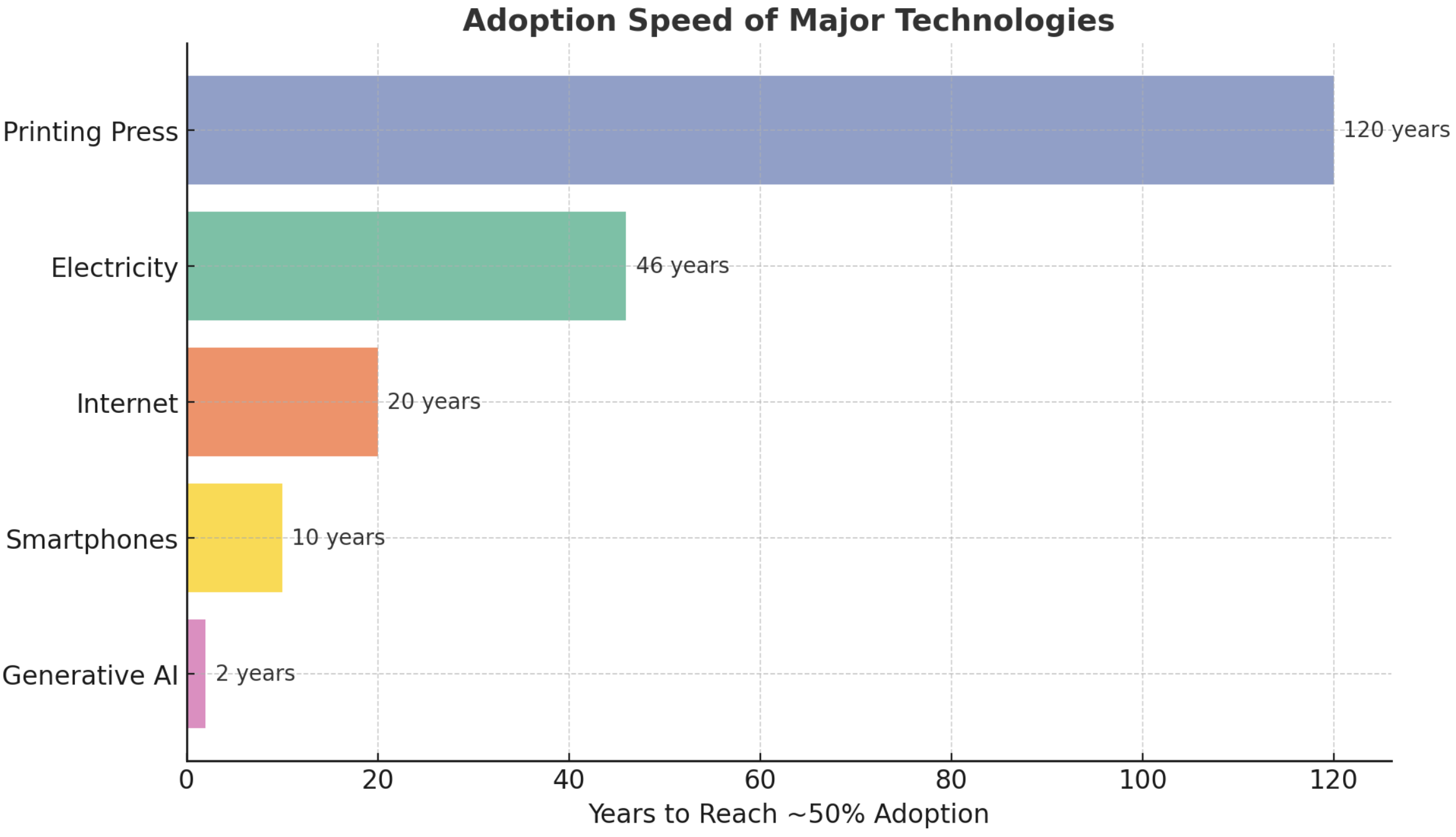
To understand the urgency, it helps to see just how fast this transformation is happening compared to the past. The printing press, introduced by Gutenberg around 1440, took more than a century to spread widely across Europe. Electricity required almost fifty years to reach half the population of industrial nations. The internet needed about twenty years to become mainstream, smartphones just ten. Generative AI has leapt into widespread use in barely two years. This is unprecedented in the history of human technology. The social, legal, and economic systems that will have to manage its consequences simply cannot adapt at that pace without deliberate intervention.
The Choice Ahead
We stand at a fork in the road. One path leads to a managed transition, where AI enhances human capability and its rewards are broadly shared. The other leads to the reckless scenario, where we lurch into disruption without safety nets and discover too late that we have broken the very systems we depend on. The technology itself will not choose for us. That choice belongs to the people who build it, the governments who regulate it, and the societies that either demand responsibility or surrender to speed. The future is still unwritten – but the ink is already in the pen.
Thanks for your time,
-Klaus

2 thoughts on “The Reckless Race: How Generative AI Could Break Society”
Hi, Klaus.
Exceptional work! But as I put it in a title about this subject: Artificial Intelligence Was Taking Over Long Before AI. So, what you wrote about “The internet needed about twenty years to become mainstream, smartphones just ten”: What’s missing in that discussion is the damage done along the way (which drove the increasingly easy adoption of all that followed). There was a time when you could write a substantive email with bullet points in summary. That time is long gone, as people only want the bullet points now (and it shows in how they miserably fail to think things through).
At each phase, “information” became increasingly fragmented (and in so doing – fragmenting minds to the point where people think everything should be easily understood in their entirely transactional mindset). And if they don’t get, they shoot the messenger for “failing” to “convince” them with information they refuse to consider.
“[T]he spread of computers – took decades to unfold, giving society time to adjust.” From where I sit, it never adjusted. All your valid concerns on AI are a product of that reality – in a world where people want to manufacture their own.
If you’d like to see more of what I have to say (and what I have in mind to address this problem and so much more): Please check out my YouTube video: Sounds of Silence: The Deafening Noise of a Nation Decades in Decline
Thanks for your time – and the sincerity in your efforts.
Rick
P.S. As my avatar image ties into this discussion, I thought I’d share this quote from where I found it almost 35 years ago:
“Shown here is a somewhat dehumanized, life-size bronze figure of a human being of no particular sex, age, race, culture, or environment. Compressed between the two wheels, it seems to present humanity as the victim of its own complicated inventions.
The wheels also symbolize the blind ups and downs of fortune. The date 1965 is inscribed on the base, and the whole sad assemblage seems to say that human history and civilization have not exactly turned out as was once more hopefully expected.”
— A History of the Modern World