

If you come from SQL Server (like in my case), PostgreSQL indexing can feel familiar at first – B-tree indexes exist, composite indexes exist, covering indexes exist. And then you run into queries like this:
WHERE payload @> '{"type":"payment","status":"failed"}'or this:
WHERE tsv @@ plainto_tsquery('postgresql')At that point, most SQL Server developers ask two questions:
- What are these operators?
- Why does PostgreSQL need a completely different index type for this?
This blog posting answers both questions – and shows why GIN indexes exist, what problems they solve, and how they compare to modern SQL Server (including SQL Server 2025 with native JSON indexes).
👉 If you want to learn more about SQL Server 2025 and PostgreSQL, I highly recommend to have a look on my upcoming online trainings about it.
First Things First: PostgreSQL Indexes Are Operator-Driven
PostgreSQL uses a fundamentally different indexing philosophy than SQL Server. In SQL Server, indexes are:
- Column-based
- Value-based
- Optimized for equality, range, and order
In PostgreSQL, indexes are:
- operator-based
- designed around how data is queried, not just how it is stored
This is why PostgreSQL has operators that look unfamiliar – but are actually very explicit.
Understanding the Two Key Operators
Before talking about GIN, you must understand what these operators mean.
The @> operator means “contains”:
payload @> '{"type":"payment"}'This means: “Does the JSON document in payload contain at least this key/value pair?“
It does not require:
- Identical JSON
- Identical ordering
- Identical structure beyond the keys provided
This is very different from SQL Server’s traditional JSON functions, which historically required explicit extraction. Before SQL Server 2025, you typically wrote:
JSON_VALUE(payload, '$.type') = 'payment'And indexed that via:
- Persisted computed columns
- Or filtered indexes
SQL Server 2025 improves this by introducing:
- Native JSON data type
- JSON indexes
However, those indexes still operate on paths and values, not on arbitrary JSON containment semantics. PostgreSQL’s @> operator answers a higher-level question: “Does this document logically include this structure?“
On the other hand, the @@ operator is used for full-text search:
tsv @@ plainto_tsquery('postgresql')This means: “Does this document’s token vector match this text query?“
Think of it as:
- Not LIKE
- Not string comparison
- But linguistic matching
SQL Server developers should compare this to Full-Text Search predicates, not to LIKE ‘%text%’.
The Need for GIN Indexes
B-tree indexes work when:
- One row = one indexed value
- Comparisons are equality or range based
- Ordering matters
A GIN (Generalized Inverted Index) is an inverted index. Instead of storing:
Row -> Value
It stores:
Value -> Many Rows
Each searchable element inside a column becomes its own index key. This is why GIN is ideal for:
- JSONB
- Arrays
- Tags
- Full-Text tokens
A Concrete Example
Let’s create a simple table that stores payment processing information:
-- Create a simple table
CREATE TABLE Events
(
    ID	        BIGINT GENERATED ALWAYS AS IDENTITY,
    OccurredAt TIMESTAMPTZ NOT NULL,
    Payload     JSONB NOT NULL
);
It will store in the column Payload the following JSON document:
{
  "type": "payment",
  "status": "failed",
  "user_id": 4711,
  "tags": ["stripe", "europe"]
}
Let’s insert some test data:
-- Insert 1mio rows
INSERT INTO Events (OccurredAt, Payload)
SELECT
    now() - (random() * interval '30 days'),
    jsonb_build_object(
        'type',
            CASE
                WHEN r < 0.80 THEN 'payment'
                WHEN r < 0.95 THEN 'login'
                ELSE 'signup'
            END,
        'status',
            CASE
                WHEN r < 0.80 THEN
                    CASE WHEN random() < 0.002 THEN 'failed' ELSE 'success' END
                ELSE
                    CASE WHEN random() < 0.01  THEN 'failed' ELSE 'success' END
            END,
        'user_id', (random() * 5000000)::int,
        'region',  CASE WHEN random() < 0.6 THEN 'eu' ELSE 'us' END,
        'provider',CASE WHEN random() < 0.5 THEN 'stripe' ELSE 'paypal' END,
        'tags',
            CASE
                WHEN random() < 0.20 THEN jsonb_build_array('retry','europe')
                WHEN random() < 0.40 THEN jsonb_build_array('stripe','europe')
                WHEN random() < 0.60 THEN jsonb_build_array('paypal','us')
                ELSE jsonb_build_array('mobile','web')
            END
    )
FROM (
    SELECT random() AS r
    FROM generate_series(1, 1000000)
) s;

-- Update Statistics
ANALYZE events;
And now we have the following query that we want to optimize:
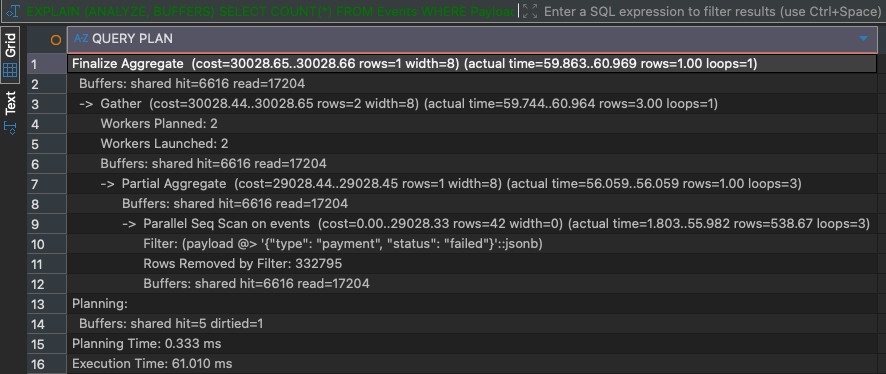
-- Execution Time: around 60ms
EXPLAIN (ANALYZE, BUFFERS)
SELECT COUNT(*)
FROM Events
WHERE Payload @> '{"type":"payment","status":"failed"}'::JSONB;
Without any index in place, this query runs for about 60ms on my system:
Let’s create a GIN index:
-- Create a GIN index
CREATE INDEX idx_EventsPayload_GIN
ON Events
USING GIN(Payload);

-- Update Statistics
ANALYZE events;
That single statement indexes:
- Every JSON key
- Every JSON value
- Every array element
This is something SQL Server JSON indexes – even in SQL Server 2025 – do not model the same way, because they remain path-centric rather than containment-centric.
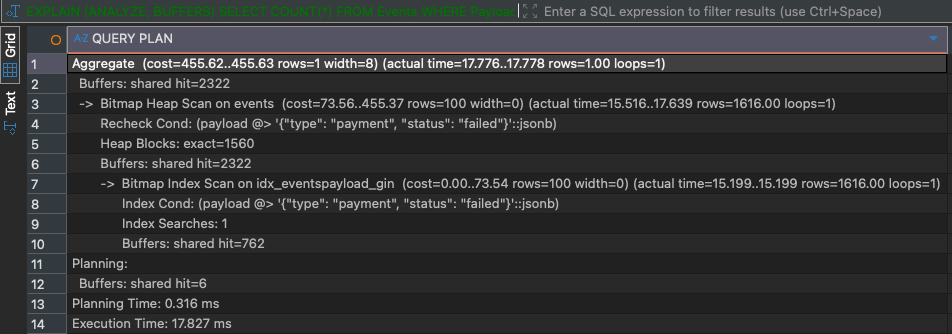
When we run now the query again, the query planner uses the GIN index, and the query finishes in around 18ms:
But GIN indexes also have some negative side-effects:
- Larger than B-Trees
- Slow down Inserts and Updates
- Do not support ordering
That last point is very critical – and leads directly to RUM.
What is RUM?
RUM is an extension, not a built-in index type. It extends GIN by storing:
- Token positions
- Ranking metadata
- Optional ordering hints
CREATE EXTENSION rum;

CREATE INDEX idx_Documents_RUM
ON Documents
USING RUM (tsv rum_tsvector_ops);
Now PostgreSQL can:
- Filter
- Rank
- and partially order results index the index
Summary
Yes, SQL Server 2025 significantly improves JSON support. But PostgreSQL’s GIN model was never about JSON alone – it is about indexing meaning, not just values. GIN exists because modern data is:
- Multi-valued
- Semi-structured
- Queried semantically
RUM exists because once filtering is cheap, relevance matters. If you approach PostgreSQL with this mindset, GIN indexes stop being “weird” – and start feeling inevitable.
👉 If you want to learn more about SQL Server 2025 and PostgreSQL, I highly recommend to have a look on my upcoming online trainings about it.
Thanks for your time,
-Klaus